Lawless Cloud
Everything you need to know for using the Lawless Cloud
- Getting started
- General Description of the User Interface
- Changing Personal Contact Data
- App Launcher
- Changing the Password
- The menu bar
- Customizing the Basic Settings
- The search bar
- The folder view
- The toolbar
- The display area
- The pop-up
- The editing window
- The notification area
- Working with Notifications
- Manually Installing Local Apps
- Using a Wizard to Set Up Local Apps
- Setting up and Configuring the Zoom Integration
- Setting the Presence Status
- The Email Components
- Viewing Emails
- Sending a new email
- Adding attachments
- Sending attachments as link
- Using signatures
- Replying to emails
- Forwarding emails
- Automatically forwarding emails
- Sending an email to appointment participants
- Sending a vacation notice automatically
- Calling the Sender or Another Recipient
- Adding Email Folders
- Moving or copying emails
- Marking emails as read or unread
- Collecting addresses
- Categorizing emails
- Showing the email source
- Using email drafts
- Creating email reminders
- Adding an email to the Portal
- Saving emails
- Importing emails
- Printing emails
- Archiving emails
- Deleting emails
- Cleaning up email folders
- Unified Mail
- Using Email Filters
- Searching for Emails
- Sending or Receiving Emails as Deputy
- Adding Email Accounts
- Address Book
Getting started
This is the first place you should start if you have not used the Lawless Cloud before.
General Description of the User Interface
Overview:
Learn which basic elements are part of the user interface and where they are located.
Detailed descriptions of the app specific user interface elements can be found in the app specific topics. Links to the app specific topics can be found at the end of each following topic.
The user interface includes the following elements:
Changing Personal Contact Data
The following options exist:
-
change personal contact data
-
create a contact picture by uploading an existing picture or by taking a new photo with the device camera
How to change your personal contact data:
-
Click the icon on the right side of the menu bar. Click on .
You can also click on in the basic settings or in the address book settings.
-
Change the data. Click on .
Tip: You can also change your personal contact data by using the User data widget in the Portal app.
How to create a contact picture:
-
Click the icon on the right side of the menu bar. Click on .
You can also click on in the basic settings or in the address book settings.
-
Click on the empty contact picture. The Edit image window opens.
-
You can upload an existing image or take a new picture with the device camera.
-
You can adjust the image section with the zoom and by moving or rotating the photo.
-
-
Click on . The photo will be inserted.
In order to edit the photo, click on it.
App Launcher
Note: The following is a schematic representation.
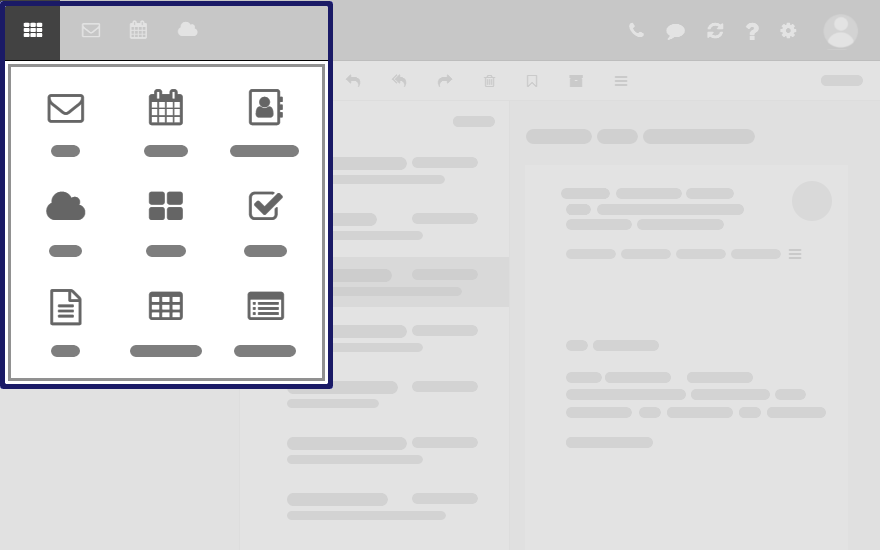
In order to show the app launcher, click the icon .

Content
-
Contains squares for launching the apps. Depending on the configuration, the number of squares can vary.
Changing the Password
Note: Depending on the configuration, the steps for changing the password might differ from this instruction. In this case, contact your administrator or host.
How to change your password:
-
Click the icon in the menu bar. Click on in the App Launcher.
-
If the User data widget is not displayed, click on on the upper right side. Click on .
Click on in the User data widget.
-
Change your password.
The menu bar
Note: The following is a schematic representation.

Content
-
icon . Opens a menu with icons for launching an app.
-
Depending on the configuration: Quick launch icons for launching frequently used apps.
The context menu allows to define the apps that should be displayed as quick launch icons.
-
icon . The icon is displayed when receiving a new notification. The icon notifies you of the number of new notifications e.g., new appointment invitations. If clicking the icon, the notification area opens.
-
Depending on the configuration: icon . Opens the call history that shows all calls or missed calls. If clicking on an entry, the window for calling this contact will be opened.
-
icon . Reloads objects from the server. Irrespective of this function, objects are refreshed in regular intervals.
-
icon . Opens a menu with further functions:
-
. Opens a context related help page.
Tip: Some windows also include the help icon. If clicking on it, the respective help for the window context is displayed.
-
Giving feedback about the groupware
-
Depending on the configuration, there are several guided tours that help you get started with the groupware.
-
. Shows information about the groupware.
-
-
icon . Opens a menu with further functions:
-
Customize settings.
-
Depending on the configuration: . Launches a wizard for setting up local apps with which you can access your groupware data.
-
-
icon. Opens a menu with further functions:
-
. Opens a window where you can adjust your personal contact data in the global address book.
-
. Signs you out from the groupware.
-


Depending on the configuration, further menu entries might be available.
Customizing the Basic Settings
In the basic settings, you can set the language, the regional settings and other personal settings.
How to customize the basic settings:
-
Click the icon on the right side of the menu bar. Click on .
-
Click on in the sidebar.
The following settings are available as default:
Language
Defines the user interface language.
More regional settings
Opens a window for customizing regional settings. The preset regional settings depend on the selected language.
Timezone
Defines the time zone to which all time-bound entries refer.
Also see Displaying multiple time zones
Design
Defines the color scheme for the user interface.
Refresh interval
Defines the interval for retrieving new objects from the server.
Default application after sign in
Defines the application that is displayed after login.
Automatic sign out
Specifies whether you are automatically signed out if you have not worked with the groupware for a specific time.
Open notification area automatically
Specifies whether the notification area automatically opens when receiving a new notification or email.
Show desktop notifications
Defines whether you will receive a desktop notification for new emails. Depending on the browser settings, the button is displayed. If clicking on the button, a browser specific dialog for allowing notifications opens.
Configure quick launchers
Opens a window that enables you to define the apps that should be displayed as quick launch icons in the menu bar. Depending on the configuration, you can set a different number of quick launch icons. You can also open the window from a quick launch icon's context menu.
My contact data
In order to change your personal contact data in the global address book, click on this button.
Change password
In order to change your password, click on this button.
Manage deputies
To define deputies for your email conversation or your appointment scheduling, click on this button.
The search bar
Note: The search bar contents are different for each app. The following is a schematic representation.
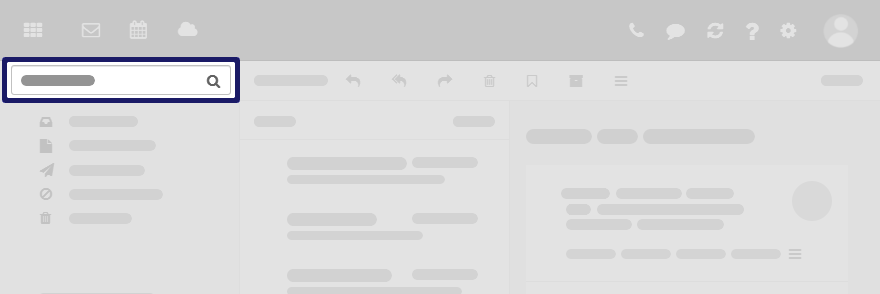
In order to display the search bar, click on in the toolbar. Enable .
Content
-
Input field for the search term
As soon as clicking into the input field, additional functions are displayed in the search bar.
-
icon . Finishes the search.
-
Functions for selecting the folder to be searched
-
icon . Opens a menu with app specific parameters for controlling the search.
Depending on the app, additional drop-downs for controlling the search are available.
-
icon . Displays a context-sensitive help.


The search result is displayed in the display area.
The folder view
Note: The folder view contents are different for each app. The following is a schematic representation.
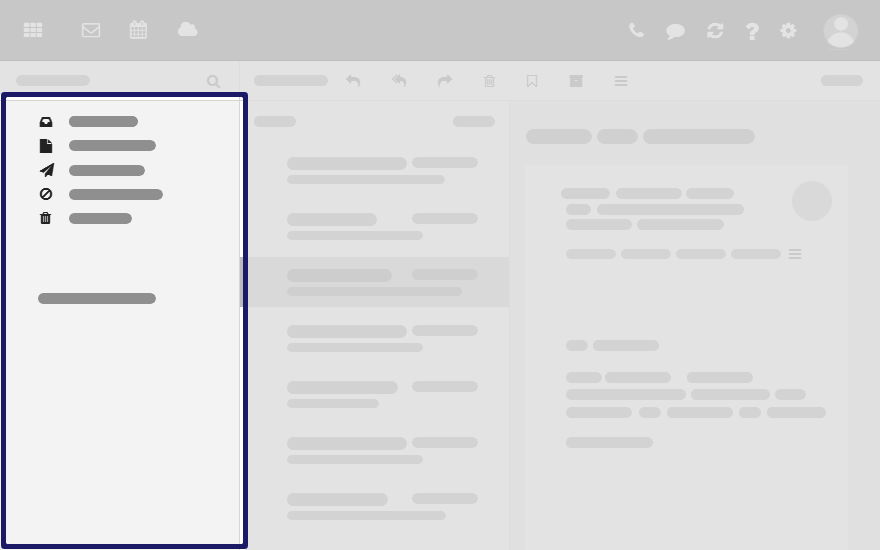
To open or close the folder view, use one of the following methods:
-
Click on in the toolbar. Enable or disable .
-
Click the or icon .


To adjust the folder view width, hover over the line between the folder view and the display area.
Content
-
The app specific folders
Folders are called differently in the following apps:
-
A folder is called address book in the Address Book app.
-
A folder is called calendar in the Calendar app.
-
-
Depending on the application or the configuration, sections for personal, public and shared folders
-
The icon next to the selected folder. It contains functions for organizing folders. You can also use the .
-
Depending on the app, further functions might be available.

The toolbar
Note: The toolbar contents are different for each app. The following is a schematic representation.
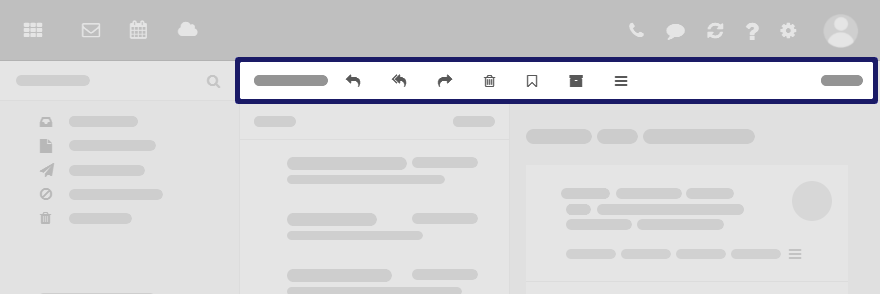
Content
-
Buttons for creating new objects, e.g. a new email or a new contact.
-
Buttons or icons for editing objects.
-
Depending on the app, further app specific buttons or icons might be available.
-
icon . Contains app specific functions for organizing objects.
-
button. Contains functions for controlling the layout in the display area and for opening or closing the folder view.

The display area
Note: The display area contents are different for each app. The following is a schematic representation.
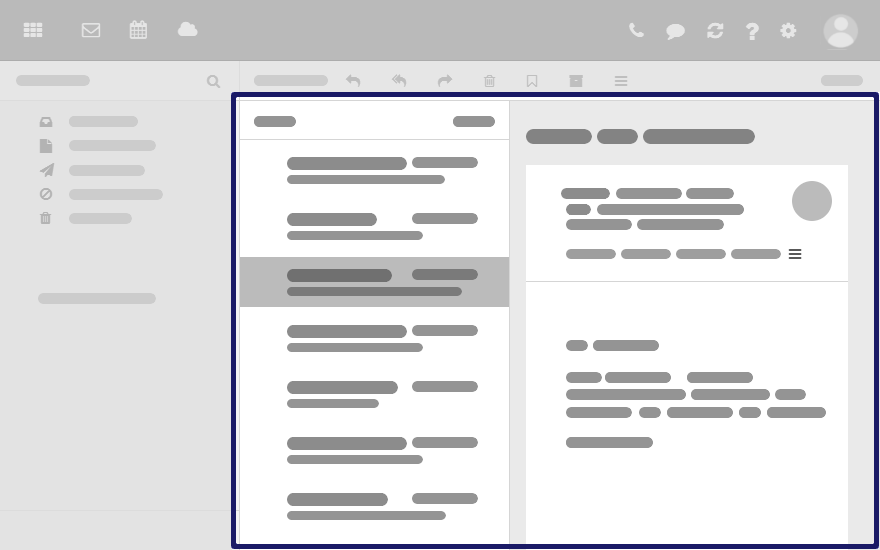
Content
-
A list of app specific objects: emails, contacts, appointments, tasks, files
To adjust the list width, hover over the line between the list and the detail view.
-
On top of the list, control elements for selecting or sorting objects are displayed.
-
The details of the object selected in the list, are displayed in a detail view.
If double-clicking on an object in the list, the content will be displayed in a window.
-
To select multiple objects, enable the option in the drop-down in the toolbar.
You can also use your system's multi selection functions.
You can change the view in the display area by clicking on in the toolbar.
The pop-up
Note: The pop-up contents are different for each app. The following is a schematic representation
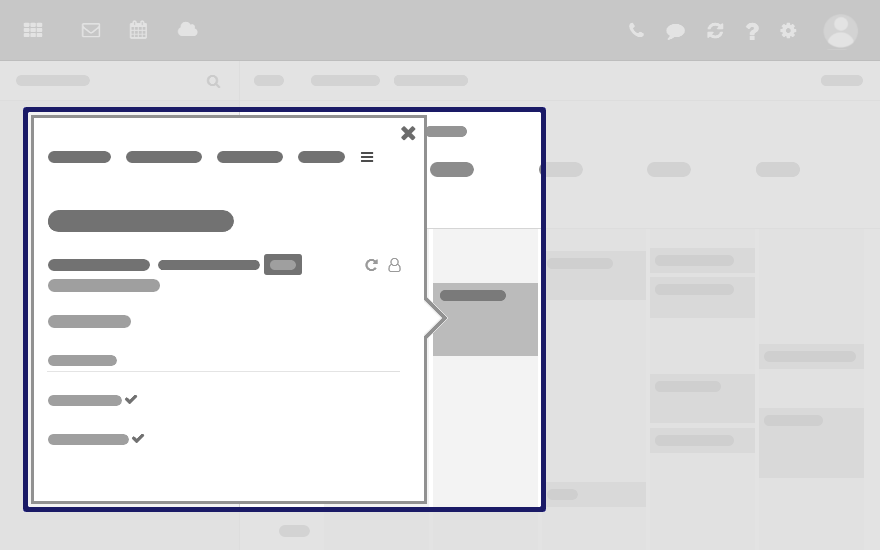
Shows an object's details. The following actions open the pop-up:
-
clicking on an email, an appointment or a task in the app Portal
-
clicking on a sender or recipient in an email's detail view
-
clicking on an appointment's or a task's participant
-
clicking on an appointment in a calendar view
Content
The editing window
Note: The editing window contents are different for each app. The following is a schematic representation.
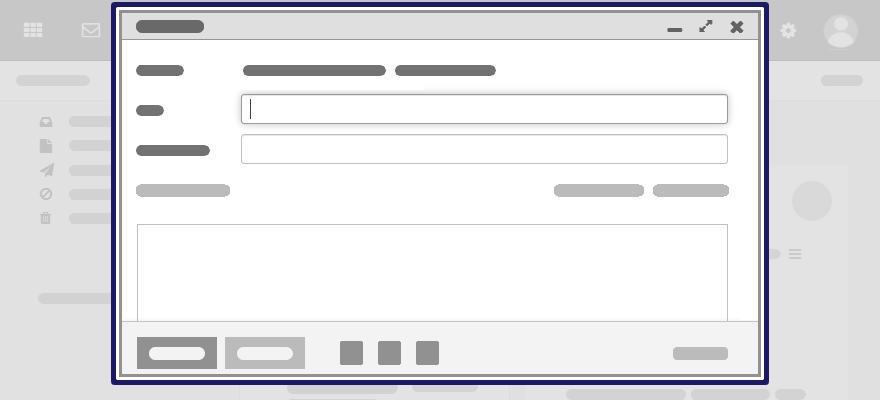
The following actions open the editing window:
-
creating or editing objects
-
editing the personal contact data
-
creating or editing simple text files
Content
-
The title bar includes the following elements:
-
window title
-
icons for setting the window position:
-
icon . Displays the editing window as icon at the bottom.
-
icon . Displays the editing window in its maximum size. If clicking the icon again, the original size is restored. You can also double-click on the title bar again to toggle the window sizes.
-
-
-
Depending on the app or function, various buttons, icons or input fields are available.


Properties
-
You can move an editing window.
-
You can activate further functions while an editing window is open.
-
You can open multiple editing windows.
-
Minimized editing windows are displayed as icons at the bottom. In order to restore an editing window, click the icon.
The notification area
Note: The following is a schematic representation.
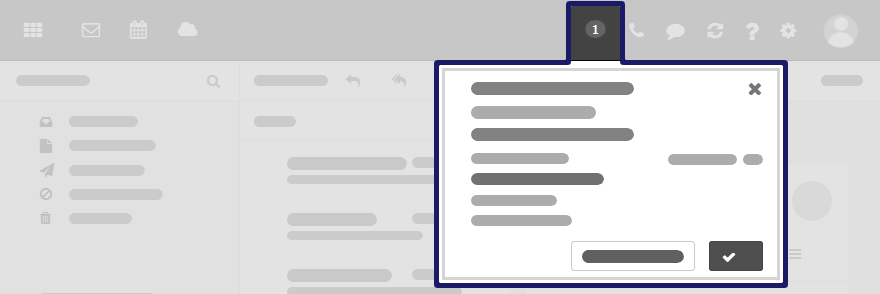
Displays notifications about the following events:
-
new appointment invitations
-
reminder for a scheduled appointment or task
The following actions open the notification area:
-
Clicking on the icon in the menu bar. The icon is displayed when receiving a new notification.
-
Depending on the settings, the notification area automatically opens if there is a new notification.
Content
-
Notifications about new invitations and upcoming events
-
Control elements for editing notifications: accept, decline, remind again, delete
Working with Notifications
You can configure the groupware to receive notifications about specific events.
You will be notified in the notification area for the following events:
-
new appointment invitations
-
appointment reminders
-
due tasks
-
tasks with a due date in the past
If you have enabled desktop notifications and the groupware is in the background, you will be informed about the following events:
-
incoming emails
Using the notification area:
-
As soon as a notification is being received, icon shows the number of new notifications. To open the notification area, click the icon.
If the notification area is to be opened automatically upon receipt of new notifications, proceed as follows:
-
Click the icon on the right side of the menu bar. Click on .
-
Click on in the sidebar.
Enable in the display area.
-
-
Show or hide notifications:
-
To close the notification area, click the icon . The notifications will be hidden.
-
In order to show the notifications again, click the icon in the menu bar.
-
To show a notification's details, click on the notification title.
-
To receive the notification again later, click on . The notification area will be closed.
-
-
Edit notifications:
-
To display appointment invitation suggestions in the calendar, click on .
-
To accept or decline an invitation, click on the respective button.
-
To receive a specific reminder again, select a value in . Click on . The notification area will be closed.
-
To mark overdue tasks as done, click on the respective button.
-
-
Delete reminders:
-
To delete a reminder, hover over the reminder. Click the icon next to the reminder.
-
If there is more than one reminder: To delete all reminders, click on at the bottom.
-

Enabling desktop notifications:
-
Click the icon on the right side of the menu bar. Click on .
-
Click on in the sidebar.
-
Enable in the notification area.
Depending on the browser settings, the button is displayed. Click the button. You are asked by the browser whether the receipt of notifications should be allowed. Grant this permission.
Note: Depending on the browser, you might have to allow the receipt of notifications in the browser settings for the setting above to take effect. Information can be found in the browser help pages.
Manually Installing Local Apps
You can manually install local Drive apps for MS Windows, macOS, iOS or Android. The local Drive apps synchronize your Drive app data with your computer or mobile device and can be connected multiple ways, either through webDAV or by downloading applications like OX drive which can funnel the data directly to your device.
Note: Depending on the configuration, those functions might not be available. In this case you can use a wizard to set up the apps.
How to install local Drive apps for computers or mobile devices:
-
Click the icon on the right side of the menu bar. Click on .
-
In the sidebar, click on .
Click the respective icon in the display area. Follow the instructions on installing the apps.
Using a Wizard to Set Up Local Apps
You can also access your emails or groupware data by using suitable apps and clients on mobile devices or computers. You can use a wizard in the groupware to install and configure those apps and clients. The wizard includes the following functions:
-
Installing and configuring apps and clients on devices such as PCs, tablets and smartphones. The supported devices are: Windows, Apple and Android.
-
Installing an email client on Windows systems. The client makes your emails, appointments, tasks and contacts locally available.
-
Installing the local Drive app for desktop and mobile devices. This app is downloaded and installed from respective the app store for the device. The local Drive apps synchronize your Drive app data with your computer or mobile device.
-
Depending on the device, the configuration might also be possible by email or SMS. Advanced users can display the configuration data for a manual configuration.
Note: Depending on the configuration, the wizard might not be available. In this case you can manually install clients and apps.
How to use the wizard:
-
Click the icon on the right side of the menu bar. Click on . The wizard will be launched.
-
Select your system and the required devices. Follow the instructions.
Setting up and Configuring the Zoom Integration
This feature is currently not public
The following options exist:
-
Set up the Zoom integration
Prior to being able to have Zoom meetings with other contacts, you have to set up the Zoom integration. To do so, you have to grant the groupware access to a Zoom account.
-
Configure the Zoom integration
You can configure the Zoom integration according to your needs.
How to set up the Zoom integration:
-
If you call a contact via Zoom in the Email, Address Book or Calendar app before having set up the Zoom integration, a window for registering a Zoom account opens. In this case, proceed with step 4.
-
Click the icon on the right side of the menu bar. Click on .
In the sidebar, click on .
-
Click on in the display area. if this button will not be displayed, the Zoom integration has been done already.
A window for registering a Zoom account opens.
-
-
Below , use the login method that you learned from your administrator or hoster.
-
To create an own Zoom account, click on . Follow the instructions.
Use one of the following methods:
-
The data of the linked zoom account will be displayed.In order to cancel the link, click the icon next to the account.

How to configure the Zoom integration:
-
Click the icon on the right side of the menu bar. Click on .
-
In the sidebar, click on .
The following settings are available:
Appointments
With those options, you can define the behavior if you select in the drop-down when creating appointments.
-
Always add a random meeting password. Defines whether the conference will be secured by an automatically created password.
-
automatically copy link to location. Defines whether the link for the Zoom meeting participation will be copied to the field.
-
Copy dial-in information to description. Defines whether the link for the Zoom meeting participation will be copied to the field.
Incoming calls
With those options, you can define the behavior for incoming Zoom calls if the groupware is in the background.
-
Show desktop notifications. Defines whether you will receive a desktop notification for an incoming Zoom call.
-
Play ringtone on incoming call. Defines whether a notification sound will be played for incoming Zoom calls.
Dial-in numbers
If you at least have a Zoom Pro account, Zoom offers dial-in numbers per country. To define the countries to be displayed in in appointment invitations, click on .
Setting the Presence Status
You can set your current presence status to indicate your availability for a call to other users.
How to set the current presence status:
-
Click the icon on the right side of the menu bar.
-
Select a presence status below . You have the following options:
-
. You are signed in and can be contacted.
-
. You are currently absent and can not be contacted.
-
. You do not want to be disturbed, e.g. if you are in a meeting.
-
. You are not signed in.
-
as an email's sender or recipient
-
in the address book list, in the address book detail view
-
as appointment participant, as task participant
-
Learn how to read, send and organize your emails in the Email app.
The Email Components
The components of the Email app user interface will be covered in depth and how.you can use them:
- The Email toolbar
- The Email folder view
- The Email categories bar
- The Email display area
- The Email list
- The Email detail view
- The Email pop-up
- The Email editing window
Viewing Emails
How to display an email:
-
Open an email folder in the folder view.
When having selected the folder and if you are using email categories, you can select a category.
To display the number of emails in a folder, hover over the folder name.
-
Click an email in the list. The content of the email will be displayed in the detail view.
-
If the option is enabled in the drop-down, all emails of a conversation will be displayed as thread.
To open or close an email that is part of a conversation, click on a free area between the sender and the date of receipt.
To open or close all emails in the conversation, click the icon on the upper right side of the detail view.
-
If the email includes a quote from a previous email, you can display the quote by clicking the icon .
-


Options:
-
To sort the email list, click on above the list.
The sorting setting will be applied to the selected email folder. You can use different settings for the single folders.
-
To combine all emails of a conversation in a single list entry, enable the checkbox in .
-
In order to select a layout, click on in the toolbar.
-
You can open the email in a window by double-clicking on the email in the list.
-
When having selected from the drop-down, a list of all emails in the folder will be shown in the display area. If clicking on an email, the email's detail view will be displayed.
Tip: In the email settings, you can define whether a notification sound is to be played for incoming emails.
Sending a new email
How to send a new email:
-
Click on in the toolbar.
-
Enter the recipients' email addresses in the field.
-
While entering the recipients, matching suggestions will be displayed. To accept a suggestion, click on it.
-
To select contacts from an address book, click the icon on the right side of the input field.
-
-
If the recipients are to see who gets a copy of the email, enter the recipients in the field.
-
If the recipients are not to see who gets a copy of the email, enter the recipients in the field.
-
To send a copy to other recipients, click on or on the upper right side.
-
-
Enter a subject. Enter the email text.
-
Click on .

Options:
-
If you do not want to send the email from your primary email account but from an external or a functional email account, select the account in the folder view.
Then, click on .
-
With drag and drop you can move the recipients between the fields , and .
-
In the email settings, you can determine that each outgoing email will also be sent as blind copy to a specific email address.
-
To format the email text or to enter images, use the formatting bar below the text.
-
If the formatting bar is not displayed, click the icon in the button bar. Enable . Enable the icon in the button bar.
You can define default values for the font style, size and color in the email settings.
-
To enter images at the current cursor position, drag one or several images from a file browser or from the desktop to the email text input field.
To remove an image, use the context menu.
-
-
You can use further options by clicking the icon in the button bar:
-
attach your signature
-
set the priority
-
attach your vCard
-
request a read receipt
-

Adding attachments
How to add attachments to an email in the email editing window:
-
Select the files to be sent as attachment.
-
To send a local file as attachment, click the icon in the button bar.
You can also add an attachment by dragging one or several files from a file browser or from the desktop to the email window.
-
Depending on the configuration, you can send the current version of a file from the Drive app as attachment. To do so, click the icon in the button bar.
-
-
You can remove an attachment if required. To do so hover over an attachment. Click the icon .


Note: An email attachment can consume more than 25% of storage space than the locally saved file.
Options:
-
Depending on the configuration, attached images can be minimized if they exceed a specified number of pixels or a specified file size. To do so, select an entry next to on the bottom right side of the attachments
Note: Images can only be minimized directly after having been uploaded. If you open an email draft or re-load the email editing window, attached images can no longer be minimized.
-
Depending on the configuration, attachments will not be sent when having reached a certain size limit. In this case, the attachment will be saved in the folder in the Drive app. The email includes a link to the attachment.
Sending attachments as link
This function allows you to send large attachments by email. This is how it works:
-
The attachments will be uploaded to a new folder below in the Drive app. The name of this folder corresponds to the email subject. The folder is shared with a public link.
-
The email recipients will receive a link for downloading the attachments.
How to send attachments as link in the email editing window:
-
Select the files to be sent as attachment.
-
To send a local file as attachment, click the icon in the button bar. Select at least one file.
You can also add an attachment by dragging one or several files from a file browser or from the desktop to the email window.
-
To use a current file version from the Drive app as attachment, click the icon .
-
-
You can remove an attachment if required. To do so hover over an attachment. Click the icon .
-
Click on . The button will be displayed.
Click on . The Drive Mail options window opens.
-
To set the expiration date for the public link, click on an entry below .
If you select an expiration date, you can let the attachment be deleted after the expiration date. To do so, enable .
Note: Depending on the configuration, those functions are optional or mandatory.
-
To protect the public link with the attachments with a password, enable . Enter a password. To view the password while entering it, click the icon on the right side in the input field.
-
To receive notifications about certain actions, enable one or several entries below .
Note: Depending on the configuration, this function might not be available.
-
Notes
-
Depending on the configuration, there might be a maximum file size for attachments that can be sent as link.
-
In the folder, the email will be marked with the icon . When viewing the email, the following information are displayed at the top of the email text:
-
A link to the folder containing the attachment.
-
Information about the expiration date and a possibly used password.
-
A list of the attachments' file names.
-

Using signatures
An email signature is text that is automatically entered in the email when being composed. It is typically used for inserting the name, company, and contact address at the bottom of the email text. You can create signatures in the plain text or html format. The following functions are available:
-
create new signature, edit existing signatures, set default signatures
-
add a signature to the email text
How to create or edit a signature:
-
Click the icon on the right side of the menu bar. Click on .
-
Click on in the sidebar. Click on .
The existing signatures will be shown in the display area.
-
To add a new signature, proceed as follows:
-
In the display area, click on . The Add signature window opens.
-
Enter a name for the signature. Enter the text for the signature.
Define whether the signature is to be entered below or above the email text.
Click on .
-
-
To edit an existing signature, you have the following options:
-
In order to edit a signature's text, click on next to the signature.
-
In order to delete a signature, click the icon next to the signature.
-
In and in , you can define the signatures to be used as default.
How to add a signature to the email text in the email editing window:
-
Click the icon in the button bar.
-
Select a signature from the list.
Replying to emails
When replying to an email, some of the email's input fields are pre-filled:
-
The sender of the email and additional recipients of the email will be automatically entered as recipients of the reply email.
-
The email subject will be entered in the subject field of the reply email. The subject will be preceded with the text "Re: ".
-
The email text will be entered in the forwarded email. Each cited line will be marked at the beginning.
How to reply to an email:
-
Select an email.
-
Click the icon in the toolbar. To also reply to all other recipients click the icon .
You can also use one of the following methods:
-
Click on the or button in the detail view.
-
Use the context menu in the email list.
To send a new email to the sender and the other recipients, click the icon in the detail view. Click on .
-
-
Fill in the details for sending the email.


Forwarding emails
If you forward an email, some of the email's input fields are pre-filled:
-
The subject of the email will be entered as the subject of the forwarded email. The subject will be preceded with the text "Fwd: ".
-
The email text will be entered in the forwarded email. The text is preceded with the following details:
-
The header "Original message"
-
Sender, recipient, date, and subject of the original message
-
If you forward multiple emails, the selected emails are sent as attachments in eml format.
How to forward an email:
-
Select one or several emails.
-
Click the icon in the toolbar.
You can also use one of the following methods:
-
Click on the button in the detail view.
-
Use the context menu in the email list.
-
-
Select one or more recipients.
-
Fill in the details for sending the email.

Automatically forwarding emails
You can let emails be automatically forwarded to another address.
How to automatically forward emails:
-
Click the icon on the right side of the menu bar. Click on .
-
Click on in the sidebar.
Click on in the display area. The Auto forward window opens.
-
Enable the button .
Enter the email address to which you want to forward the messages.
In order to keep a copy of the email, enable .
The auto forwarding will be entered as email filter. If additional filter rules are to be applied after the auto forwarding, enable . You can also edit the auto forwarding in the email filter settings.
-
Click on .

Sending an email to appointment participants
How to send an email to all appointment participants:
-
Depending on the selected view, you have the following options in the Calendar:
-
In a calendar view, click on an appointment with multiple participants. Click the icon in the pop-up. Click on .
-
In the list view, double-click on an appointment with multiple participants. The appointment will be displayed in a window. Click the icon . Click on .
-
-
Fill in the details for sending the email.
Sending a vacation notice automatically
A vacation notice informs the sender of an email that you will not retrieve your emails for a specific period of time. You can set the following:
-
the subject and text of the vacation notice
-
the time frame when the vacation notice is active
-
the email addresses for which the vacation notice is active
How to create and activate a vacation notice:
-
Click on in the toolbar. Click on at the bottom.
You can also use the button in the email settings.
The Vacation notice window opens.
-
Enable the button .
-
To define the time range for sending the vacation notice, enable . Set the start and end date.
Note: Depending on the configuration, this setting might not be available.
-
Enter a subject and a text for the vacation notice.
-
In order to display all options, click on .
-
You can specify an interval for sending a vacation notice if there are several emails from the same sender.
-
You can specify the sender address to be used for sending the vacation notice.
-
The vacation notice will be sent if messages are reaching your primary email address. You can also activate a vacation notice if messages are reaching your other email addresses.
-
If a vacation notice is active, the following is displayed:
-
On the email settings page, the button is marked with an additional icon.
-
In the Email app, a notification is displayed above the email list. If clicking on the notification, the Vacation notice window opens.
TIP: The vacation notice will be entered as email filter. You can also edit the vacation notice in the email filter settings.
Calling the Sender or Another Recipient
This feature is not yet public.
You can launch an audio or video conference with an E-Mail's sender or recipient by calling the sender or recipient.
Prerequisite: You have set up an account with an audio or video conference provider, e.g. Zoom, Jitsi
How to call an email's sender or recipient:
-
Select an email.
-
Click on the sender or on a recipient in the detail view. A pop-up opens.
An icon below the name indicates the contact's presence status.
-
In the pop-up, click the icon. In the menu, click on an audio or video conference provider, e.g. Zoom. The window for calling the contact opens. Click on .
Adding Email Folders
With email folders you can organize your emails, e.g. by separately saving emails for customers or projects. Learn how to create additional email folders below your primary email account.
How to create a new email folder:
-
Select the folder in which you want to create the new sub-folder in the folder view.
-
Click the icon next to the folder name. Click on .
A window opens.
-
Enter a name. Click on .
Moving or copying emails
The following options exist:
-
move or copy individual emails or a complete email conversation to another email folder
-
move all emails of an email folder
How to move or copy an email:
-
Select one or several emails.
-
Click the More actions icon in the toolbar or in the detail view. Select or .
You can also use the context menu in the email list.
A window opens.
-
Select a folder. You can also create a new folder.
Tips:
- To move emails of a specific sender to a folder, you can create a new rule when moving emails.
- You can also move the selected objects by dragging the objects from the folder view to a folder.
- In order to move all emails from a folder, click on above the list. Select .
Marking emails as read or unread
Unread E-Mails are marked with the Unread icon . The following options exist:

-
mark single emails as read or unread
-
mark all emails of an email folder as read
How to mark an email as unread or read:
-
Select one or several emails.
-
Click the More actions icon in the toolbar or in the detail view. Select or .
Or:
-
For single emails, click the icon or the icon .
-
Use the context menu in the email list.
-

Tip: To mark all emails in a folder as read, click on above the list. Select .
Collecting addresses
The following options exist:
-
Automatically collect new email addresses when sending or reading emails by activating this function in the email settings.
-
Manually adding email addresses to an address book
How to manually add an email address to an address book:
-
Select an email.
-
Click on the sender's or a recipient's name in the detail view.
Click on in the popup.
Note: This function is only available for new contacts.
Categorizing emails
This feature is not yet publicly released. Sooooooon
Depending on the configuration, you have several options for categorizing emails. The following options are available:
-
a colored label
-
a flag
How to categorize an email:
-
Select one or several emails.
-
To add a colored label, click the icon in the toolbar or in the detail view. Select a color.
In order to remove the label, again click the icon in the toolbar or in the detail view. Select .
-
To add a flag, click the icon in the toolbar or in the detail view.
You can also use the context menu in the email list.
To remove the flag, use one of the following methods:
-
Again click the icon in the toolbar or in the detail view.
-
Use the context menu in the email list.
-


Tip: To sort emails by flags, click on above the list.
Showing the email source
The email source contains the complete content of an email i.e., the complete email header data.
How to display the email source:
-
Select an email.
-
Click the icon in the toolbar or in the detail view. Select .
You can also use the context menu in the email list.
Using email drafts
While composing an email, the email is automatically saved as an email draft in regular intervals and the following options exist:
-
Edit or send an email draft.
-
Edit or send a copy of an email draft.
The email draft will be deleted after it has been sent. To keep the email draft, you can edit and send a copy.
Note: If you use an external email account while composing an email, the email draft will be saved in the folder below your primary email account, not below the external email account.
How to use an email draft:
-
Select an email in the folder.
-
Click on or on in the toolbar.
Edit the content.
-
You can finish editing the email or send the email:
-
In order to finish editing the email, click the icon in the title bar.
You can save or delete the draft.
-
To send the E-Mail, click on .
-

Creating email reminders
You can activate a reminder for an email. This function creates a task and reminds you of the due date.
How to create an email reminder:
-
Select an email.
-
Click the icon in the toolbar or in the detail view. Select .
Note: When having selected an email conversation, this function is only available in the detail view, not in the toolbar.
-
Complete the details in the Remind me window.
Adding an email to the Portal
You can add an email as widget to the Portal.
How to add an email to the portal:
-
Select an email.
-
Click the icon in the toolbar or in the detail view. Select .
Note: When having selected an email conversation, this function is only available in the detail view, not in the toolbar.
Saving emails
You can save an email as a text file. The text file has the file extension EML. If you select multiple emails, an eml file will be created for each email. The eml files will be saved as zip archive then.
How to save an email:
-
Select one or several emails.
-
Click the icon in the toolbar or in the detail view. Select .
-
Fill in the details for saving the file.
Importing emails
You can import an email that is available in the EML format.
How to import an email:
-
Open the email folder to which you want to import the email.
-
Drag the eml file from a file browser or the desktop to the email list.
Printing emails
You can print the content of an email or several emails.
How to print an email's content:
-
Select one or several emails.
-
Click the icon in the toolbar or in the detail view. Click on in the menu.
You can also use the context menu in the email list.
A window with a print preview opens.
-
If required, change the printer settings. Click on the button.
Archiving emails
When archiving emails, those emails are moved to the folder. The folder contains a separate sub-folder for each calendar year. The archived emails are saved to those sub-folders sorted by the year of receipt. The folder is created as soon as you initially use this function. The following options exist:
-
archive a folder's emails that are older than 90 days
-
archive single emails
How to archive an email folder's content:
-
Select an email folder in the folder view.
-
You have the following options:
-
Click on above the list. Select .
-
Click the icon next to the folder name. Click on .
-
-
In the Archive messages window click on .
How to archive single emails:
-
Select one or several emails.
-
Click the icon in the toolbar.
You can also use one of the following methods:
-
Press the [a] key on the keyboard.
-
Use the context menu in the email list.
-

Deleting emails
The following options exist:
-
Delete individual emails or entire email conversations. By default, the emails are moved to the Trash folder.
-
Delete all emails of an email folder. By default, the emails are moved to the Trash folder.
-
Recover deleted emails from the trash.
-
Permanently delete emails from the trash. You can also permanently delete all emails from the trash by emptying the trash.
Warning: If you enable the email settings option Permanently remove deleted emails you will not be able to recover deleted email messages. It is recommended that you not use this setting.
How to delete an email:
-
Select one or several emails.
-
-
Press the [Del] or [Backspace] key on the keyboard.
-
Use the button in the detail view.
-
Use the context menu in the email list.
Click the icon in the toolbar.
You can also use one of the following methods:
-
Result: The email will be moved to the folder.
How to delete all emails of a folder:
-
In the folder view, select the folder which emails you want to delete.
-
-
Click on above the list. Select .
-
Click the icon next to the folder name. Click on the button.
You have the following options:
-
Result: The email will be moved to the folder.
How to recover deleted emails:
-
Open the folder in the folder view.
-
Select one or several emails.
-
Click the icon in the toolbar. Click on .
-
Select a folder in the Move window. Click on the button.
How to permanently delete an email:
Warning: Permanently deleted emails can not be recovered. Before permanently deleting an email, make sure you no longer need the email.
-
Open the folder in the folder view.
-
Select one or several emails.
-
Click the icon in the toolbar.
How to permanently delete the content of the Trash folder:
Warning: Permanently deleted emails can not be recovered. Before permanently deleting an email, make sure you no longer need the email.
-
Select the folder in the folder view.
-
Click the icon next to the folder name. Click on .
-
Confirm that you want to empty the folder.
Cleaning up email folders
Depending on the email client's settings, emails that you deleted from within an email client like Apple Mail, MS Outlook or Mozilla Thunderbird, might be deleted only after having signed out from the client. In the meantime, those emails will be shown as crossed out in the groupware. To delete those emails clean up the email folder.
Note: Depending on the configuration, this function is not available as such emails are not displayed.
How to clean up an email folder:
-
In the folder view, select the folder that you want to clean up.
-
Click the icon next to the folder name. Click on .
Unified Mail
With Unified Mail you can display emails from multiple email accounts in one central folder. This gives you a quick overview of the multiple email accounts' inboxes. Unified Mail can be described as follows:
-
In addition to an email account's inbox, the folder shows a further view for the account's emails. The emails actually exist only once.
-
emails in the Inbox's subfolders are not displayed in the folder.
-
The emails in the folder are marked with the email account's name in the list.
To use Unified Mail, enable the function for one or several email accounts.
How to activate Unified Mail for an email account:
-
Click the icon on the right side of the menu bar. Click on .
-
In the sidebar, click on .
-
Click on next to an email account in the display area. The settings are displayed in a pop-up.
-
Enable .
-
Click on at the bottom of the pop-up.
Using Email Filters
Overview:
E-Mail filters help you organize incoming E-Mail messages. An email filter consists of one or several rules. By setting rules you can e.g. trigger the following actions:
- The email will be moved to a specific email folder.
- The email is forwarded to another email address.
- The email is marked as read.
Using email filters:
- Create email folders.
- Create one or several rules.
- Specify an order for the rules.
- Set if subsequent rules are to be processed when a rule matches.
Filter Options:
- Creating new rules
- Adding a condition
- Adding an action
- Creating a new rule when moving
- Creating new rules for the subject and the sender
- Changing a rule
- Applying a rule to existing emails
Note: For the following instructions and examples, it is assumed that the complete range of email filter functions is available. Depending on the configuration, some functions might not be available.
Searching for Emails
Email search criteria:
-
search terms for subject, email text, sender, recipients, attachment name
-
Search terms for a time range. Searches for emails that you received within the time range. You define a valid time range with the following details.
-
The key words today, yesterday, last week, last month, last year
-
The key words for those time intervals: last 7 days, last 30 days, last 365 days
-
A day of the week, e.g. Monday
-
A specific month, e.g. July
-
A four digit date, e.g. 2015
-
A date, e.g. 1/31/2015
-
A date interval, e.g. 12/1/2014 - 1/31/2015
-
-
folders that are to be searched
-
only search for emails with an attachment
Searching for emails:
-
Click on the input field. Enter a search term in the input field.
The search menu opens.
-
If clicking on the search term or pressing enter, the following data sources are searched: sender, recipient, subject, email text
-
In order to only search in the subject, click on .
Accordingly, you can limit the search to the email text or to attachment file names.
-
In order to search for senders or recipients matching the search term, click on a name. You can define whether to search the sender, recipients or both. To do so, click on next to the name.
-
In order to search for emails within a specific time range, use a valid time range as search term.
-
-
Define the data sources to be searched by clicking on an entry in the search menu.
-
The search results are displayed in the list that is shown in the display area. For each search result, the folder with the found object is displayed.
-
-
To select a folder for the search, click on the folder name next to the input field.
-
If you select , all folders and sub-folders of the internal email account are searched. Note: Depending on the email server, this function might not be available. In this case, only the current folder will be searched, no sub-folders.
-
If you select a specific folder or the folder of an external email account, only this folder is searched, but no sub-folders.
-
-
To limit the search to E-Mails with an attachment, click on next to the input field. Enable .
-
To refine the search result, enter further search terms: To remove a search term, click the icon next to the search term.
-
In order to finish the search, click the icon in the input field.

Sending or Receiving Emails as Deputy
Learn how to act as another user’s deputy. Depending on the permissions granted by this user, you can do the following:
-
read emails in the user’s inbox
-
edit, manage or delete emails in the user’s inbox
-
send emails on behalf of the user
How to send emails as deputy:
-
Use one of the following methods:
-
Click on in the toolbar.
Click on the sender address next to in the email editing window. Select the sender on whose behalf you want to send the email.
-
In the folder tree under , open the inbox of the user who appointed you as deputy.
Click on in the toolbar.
Next to , the sender on whose behalf you want to send the email will be pre-entered.
-
-
Complete the steps for composing and sending the email.
Depending on the configuration, the email text will include a note informing the recipients that the email has been sent by a deputy.
The recipient will see the following senders in the display area:
If the recipient replies to the email, the reply will be sent to the sender and the deputy.
How to read, edit or organize emails as deputy:
-
In the folder tree under , open the inbox of the user who appointed you as deputy.
-
Depending on the permissions that have been granted to you, you can do the following:
-
As viewer, you can read all emails. You can mark a single email as read, assign a color to the email or print the email.
-
As editor, you can also mark all emails in the inbox as read.
-
As author, you can also create subfolders, move a single email or move all emails in the inbox.
-
Adding Email Accounts
As default, you use your primary email account in Lawless Cloud. If you use further email accounts like e.g. GMail, you can add those accounts to the groupware. This allows you to access those accounts' emails from within the groupware.
Adding an email account:
-
Click on in the folder view. The Add Mail Account window opens.
-
Click an icon. The further procedure depends on the email account provider.
-
For some providers, a new browser window opens. Log in with your credentials to grant access to the email account.
-
If the provider asks you for the permission to access the data, grant this permission.
-
For some providers, enter your credentials in the Add Mail Account window. Then, click on .
You can also manually enter the required data by clicking on .
-
-
If the emails in this account are also to be shown in the folder, enable .
Note: Depending on the configuration, this function might not be available.
An entry for the email account appears in the folder view. The entry contains this account's email folders. Open one of those folders to do the following:
If the access to the email account fails, a warning icon will be displayed next to email account's name. Depending on the email provider, you will get troubleshooting notes when clicking the warning icon.
Address Book
Learn how to record, use and organize your contacts in the Address Book app. How to launch the Address Book app: - Click the All Applications icon in the menu bar. Click on Address Book in the App Launcher.
The Address Book Components
The Address Book toolbar
Contains functions for adding, editing and organizing contacts. Notes:
-
Some functions are only available if you opened an address book for which you have the appropriate permissions to create or edit objects.
-
Some buttons are only displayed if the selected contacts have an email address.
Content
-
. Creates a new contact or a new distribution list.
-
. Edits the contact's data.
-
. Sends an email to the contact.
-
. Invites the contact to an appointment.
-
. Deletes the contacts selected by you.
-
icon . Opens a menu with further functions.
-
. Opens a menu with checkboxes for controlling the view.
-
. Opens or closes the folder view.
-
. Displays a checkbox next to each contact in the list. This allows to select multiple contacts to edit them at once.
-
The Address Book folder view
Displays the address books.
In order to display the folder view, click on in the toolbar. Enable .
Content
-
. Contains your personal address books.
-
. Opens a menu with functions for creating address books and for subscribing to external or shared address books.
-
. Opens a window where you can adjust your contact data in the global address book.
-
. Contains address books shared with all users.
-
. Contains address books shared with you by other users.
Depending on the configuration, public address books and shared address books might not be available.
The Address Book navigation bar
Contains letters in alphabetical order. If clicking on a letter, the list jumps to the contacts with this initial letter.
The Address Book display area
Contains the contacts list and a contact's detail view.
The Address Book list
Displays a list of contacts in the opened address book.
Content
-
The name of the selected address book.
The number of contacts in this address book.
-
The following details are displayed for each contact:
-
a picture if uploaded
-
last name, first name
-
business data, if entered
Names that start with a figure or a special character are displayed below at the top of the list. Names that start with a special sign are displayed below at the bottom of the list.
-
The Address Book detail view
Shows the data of the contact that you selected in the list. If double-clicking on the contact in the list, the data are displayed in a window.
Content
-
a picture if uploaded
-
last name, first name
-
business data, if entered
-
Depending on the configuration: The contact's current availability for calls
-
Depending on the configuration: Icons for communicating with the contact:
-
. Opens the window for composing an email.
-
. Opens a menu with functions for calling.
-
. Opens the window for creating an appointment.
-
-
further contact data, if set:
-
personal data, business data
-
Email addresses. If clicking on an email address, the page for sending a new email is displayed.
-
Business and private phone numbers. If clicking on a number, a function for making a call opens, if available.
-
Business and private addresses. In the address book settings, you can define whether a map service for displaying the address should be used when clicking on an address.
-
attachments
-


The contact editing window
This window is used when creating a new contact or editing an existing one.
In order to open the window, do one of the following:
-
Select from the toolbar. Click on .
-
Select a contact. Click on in the toolbar.
Content
-
Contact picture
Click on the contact picture to edit it or to upload a new contact picture.
-
Contact data input fields:
-
,
-
,
-
,
-
-
Elements for adding additional input fields:
If clicking the icon , an additional field and its data will be deleted.
-
-
input field
-
. Adds input fields for different postal addresses.
-
. Adds files.


The distribution list editing window
This window is used when creating a new distribution list or editing an existing one.
In order to open the window, do one of the following:
-
Select from the toolbar. Click on .
-
Select a distribution list. Click on in the toolbar.
Content
-
input field for the name of the new distribution list
-
input field for the email addresses of the distribution list's contacts